The formula, in plain English
The Riegel formula is the standard way to predict race times. It takes a recent race time and scales it to a longer distance, adding a little extra for fatigue. The extra is controlled by a number called the exponent, usually 1.06. Research on recreational runners found the standard formula is often too optimistic for the marathon, especially for runners on lower weekly mileage.
So a more realistic approach adjusts the exponent for your training: about 1.05 if you run more than 70 km a week, 1.06 between 40 and 70 km, and 1.08 under 40 km. I hope this makes sense.
Worked examples
| Recent race | Over 70 km/week (1.05) | 40–70 km/week (1.06) | Under 40 km/week (1.08) |
|---|---|---|---|
| Half marathon 1:45:00 | 3:37:24 | 3:38:55 | 3:41:58 |
| Half marathon 2:00:00 | 4:08:28 | 4:10:12 | 4:13:41 |
| 10 km 48:30 | 3:39:55 | 3:43:07 | 3:49:38 |
| 10 km 55:00 | 4:09:24 | 4:13:01 | 4:20:24 |
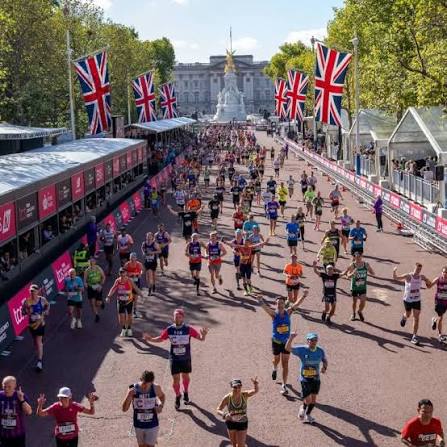
Notice that a 10 km time predicts a wider range than a half marathon does. The closer your recent race is to the marathon distance, the more reliable the prediction.
Take your half-marathon time in minutes and multiply by 2.07 if you run over 70 km a week, 2.08 for 40–70 km, or 2.11 for under 40 km. A 1:45 half (105 minutes) × 2.08 = about 218 minutes, or 3:38. Then adjust for the weather on the day. Or let our free race time predictor do it for you.
Still need somewhere to stay?
London is expensive on the best of days and fills up fast for marathon weekend. Find a room or a runner to share with on BibBuddy Race Stays.
Find a stay →Free to use · Built by runners, for runners
Adjusting for London on the day
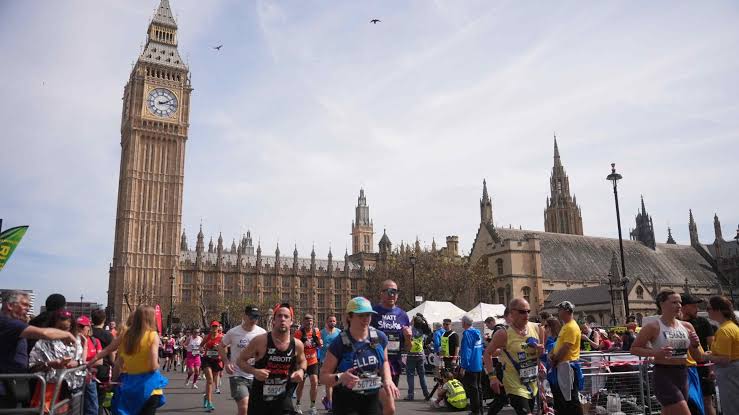
- Weather. London in spring is usually cool, but it has had warm years. If the forecast is warm, slow your goal using our hot race day guide.
- Crowds. London is busy. Expect the first few kilometres to be slower than goal pace and do not try to make it up straight away.
- GPS. Tall buildings and tunnels can confuse watch GPS. Use the official kilometre or mile markers for pacing.
- Pacers. If there are pace groups, join the one for your goal or slightly slower.
Choosing your goal
Use your most recent half marathon if you have one.
Can you hold that pace for a good chunk of a long run?
A slightly slower target for if the day is warm or the legs are not there.
An even or slightly negative split is usually fastest.
Frequently asked questions
How do I predict my London Marathon time?
Use a recent half marathon or 10 km in the Riegel formula, with an exponent of about 1.05–1.08 depending on your weekly mileage.
Is the Riegel formula accurate for the marathon?
Research shows the standard 1.06 exponent is often too optimistic for runners on low mileage, so adjusting for training volume gives a more realistic result.
What half marathon time do I need for a 4-hour marathon?
Roughly 1:55 if you run 40–70 km a week, faster if your mileage is lower.
Can I trust my GPS watch in London?
Tall buildings and tunnels can affect GPS accuracy, so use the official course markers for pacing.
Running London?
Find a room near the start, or runners to share with, on BibBuddy.
Browse BibBuddy →Free · No signup needed
Race-entry windows, spare-bib tips and new guides
Every week or two. Free, and you can unsubscribe anytime.